Research

My interest in astronomy is motivated by a deep desire to understand the formation of structure in the Universe and the physical mechanisms that drive it. I am particularly drawn to the topics of star formation, with gravity shaping structures on progressively smaller scales ranging from the cosmic web to stellar cores, and stellar feedback that injects matter, momentum and energy into the surrounding interstellar medium and has a rippling effect up the scales affecting the dynamics and lifetimes of giant molecular clouds and even galaxy evolution. As a result of the highly complex nature of these processes, there are many aspects of star formation and feedback that remain not yet understood, such as the interconnectedness of scales, the effects of environmental variation and extreme formation conditions.
My interest in the underlying physics of these processes has drawn me towards numerical modelling, but for me this comes hand-in-hand with using the models to interpret observational data. In addition, I find the exploration and development of new numerical methods and tools to be a highly rewarding task which enables addressing new research questions.
Star Formation in the Central Molecular Zone
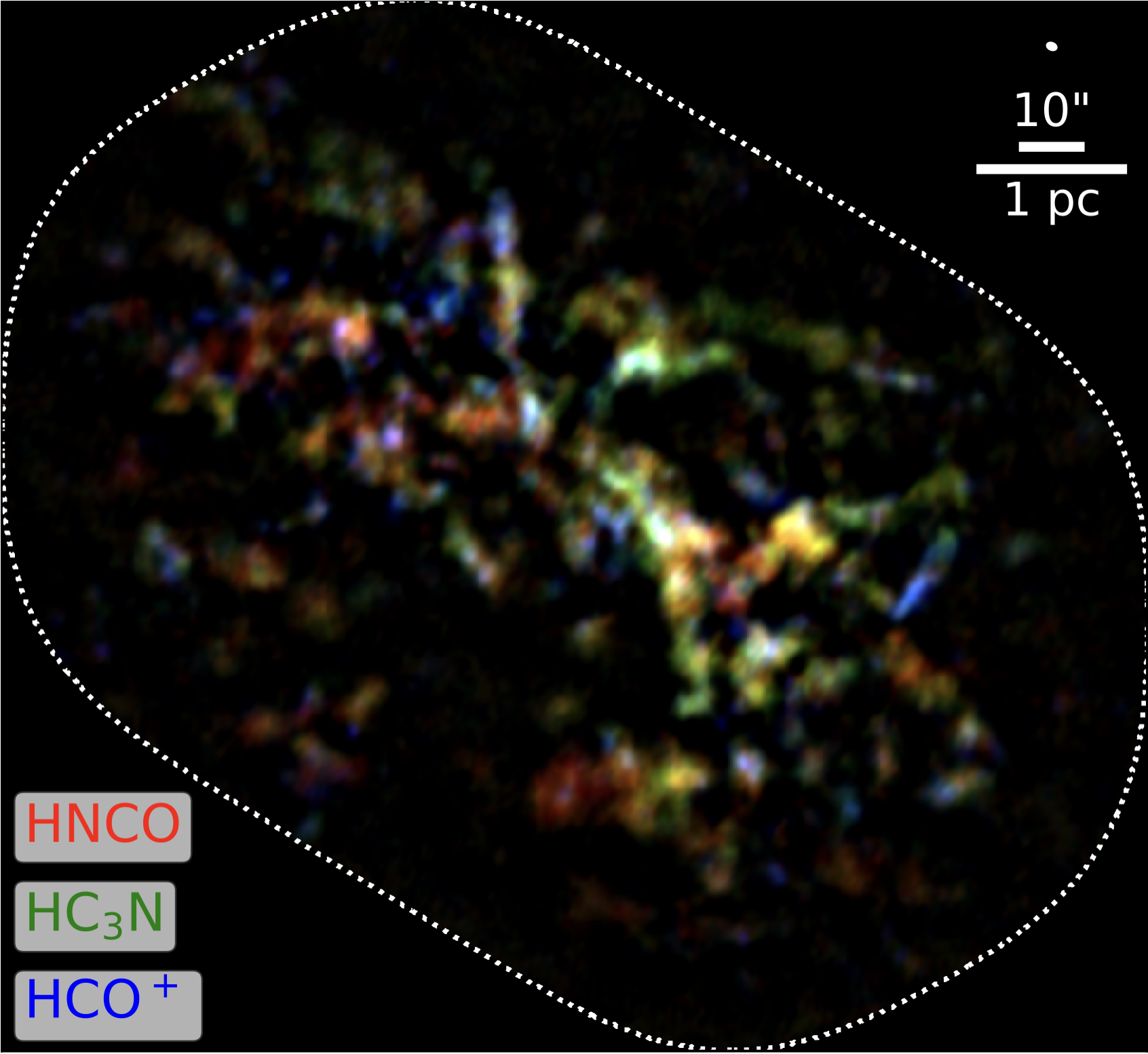
The Galactic gravitational potential as a driving mechanism of gas structure and kinematics in the CMZ.
Synthetic ALMA emission line observation of the Brick cloud (Petkova et al. 2023a), combining HNCO (red), HC3N (green) and HCO+ (blue). The synthesised beam is shown in the top right corner.
An important open question in star formation is how the process is impacted by the environment. As a postdoctoral researcher at Heidelberg University, I studied the effect of the Galactic potential on the structure and kinematics of the gas within cloud-scale hydrodynamics simulations, and compared them to the properties of the gas from high-resolution ALMA observations. The resulting publications from my work have collectively demonstrated that including the effects of the Galactic potential in simulations reproduces observed cloud properties in the CMZ, such as column densities, aspect ratios, velocity dispersions, and even a steep size-linewidth relation (Kruijssen, Petkova et al. 2019; Petkova et al. 2023a, 2023b).
As part of my work in Petkova et al. (2023a), I created synthetic emission maps from the simulations by performing line radiative transfer with the code POLARIS, and then further convolving the result with ALMA’s synthesised beam. The synthetic observations that I produced helped motivate an approved ALMA Large Programme (ALMA CMZ Exploration Survey (ACES); PI: S. Longmore), which has subsequently observed the entire reservoir of potentially star-forming gas in the Galactic Centre at high spatial (~0.05 pc) and spectral resolution (~0.2 km/s). ACES is a large international collaborative project which brings together the Galactic Centre community (~160 members from 5 continents). Since 2022 I have been co-leading the theory and simulations work package within ACES, where we develop a comprehensive suite of Galactic Centre MHD simulations, which we are using to interpret the ACES data.
-
Circumnuclear eccentric gas flow in the Galactic Center revealed by ALMA CMZ Exploration Survey (ACES)
Sofue Y, Oka T, Longmore SN, Walker D, Ginsburg A, Henshaw JD, Bally J, Barnes AT, Battersby C, Colzi L, Ho P, Jimenez-Serra I, Kruijssen JMD, Mills E, Petkova MA, Sormani MC, Wallace J, Armijos-Abendaño J, Dutkowska KM, Enokiya R, García P, Gramze S, Henkel C, Hsieh PY, Hu Y, Immer K, Iwata Y, Karoly J, Klessen RS, Kohno K, Krumholz MR, Lipman D, Morris MR, Nogueras-Lara F, Pineda JE, Martín S, Requena-Torres MA, Rivilla VM, Riquelme-Vasquez D, Sánchez-Monge A, Santa-Maria MG, Smith HA, Tolls V, Wang QD, PASJ, 77, L55 (2025)The Galactic-Centre Arms inferred from ACES (ALMA CMZ Exploration Survey)
Sofue Y, Oka T, Longmore SN, Walker D, Ginsburg A, Henshaw JD, Bally J, Barnes AT, Battersby C, Colzi L, Ho P, Jimenez-Serra I, Kruijssen JMD, Mills E, Petkova MA, Sormani MC, Wallace J, Armijos-Abendaño J, Dutkowska KM, Enokiya R, Fukui Y, García P, Guzman A, Henkel C, Hsieh PY, Hu Y, Immer K, Jeff D, Klessen RS, Kohno K, Krumholz MR, Lipman D, Morris MR, Nogueras-Lara F, Nonhebel M, Ott J, Pineda JE, Martín S, Requena-Torres MA, Rivilla VM, Riquelme-Vasquez D, Sánchez-Monge A, Santa-Maria MG, Smith HA, Tanvir TS, Tolls V, Wang QD, PASJ, 77, 687 (2025).Disruption of massive molecular cloud by supernova in the Galactic Centre: Initial results from the ACES project
Nonhebel M, Barnes AT, Immer K, Armijos-Abendaño J, Bally J, Battersby C, Burton MG, Butterfield N, Colzi L, García P, Ginsburg A, Henshaw JD, Hu Y, Jiménez-Serra I, Klessen RS, Liang F-H, Longmore SN, Lu X, Martín S, Nogueras-Lara F, Petkova MA, Pineda JE, Rivilla VM, Sánchez-Monge A, Santa-Maria MG, Smith HA, Sofue Y, Sormani MC, Walker DL, Wang QD, Williams GM, Xu F-W, A&A, 691, A70 (2024).Magnetic field morphology and evolution in the Central Molecular Zone and its effect on gas dynamics
Tress RG, Sormani MC, Girichidis P, Glover SCO, Klessen RS, Smith RJ, Sobacchi E, Armillotta L, Barnes AT, Battersby C, Bogue KRJ, N. Brucy N, Colzi L, Federrath C, Garcia P, Ginsburg A, Goller J, Hatchfield PH, Henkel C, Hennebelle P, Henshaw JD, Hirschmann M, Hu Y, Kauffmann J, Kruijssen JMD, A. Lazarian A, Lipman D, Longmore SN, Morris MR, Nogueras-Lara F, Petkova MA, Pillai TGS, Rivilla VM, Sanchez-Monge A, Soler JD, Whitworth D, Zhang Q, A&A, 691, A303 (2024).Kinematics of Galactic Centre clouds shaped by shear-seeded solenoidal turbulence
Petkova MA, Kruijssen JMD, Henshaw JD, Longmore SN, Glover SCO, Sormani MC, Armillotta L, Barnes AT, Klessen RS, Nogueras-Lara F, Tress RG, Armijos-Abendaño J, Colzi L, Federrath C, García P, Ginsburg A, Christian Henkel C, Martín S, Riquelme D, Rivilla VM, MNRAS, 525, 962 (2023).The complex multi-scale structure in simulated and observed emission maps of the proto-cluster cloud G0.253+0.016 (‘the Brick’)
Petkova MA, Kruijssen JMD, Kluge AL, Glover SCO, Walker DL, Longmore SN, Henshaw JD, Reissl S, Dale JE, MNRAS, 520, 2245 (2023).The initial conditions for young massive cluster formation in the Galactic Centre: convergence of large-scale gas flows
Williams BA, Walker DL, Longmore SN, Barnes AT., Battersby C, Garay G, Ginsburg A, Gomez L, Henshaw JD, Ho LC, Kruijssen JMD, Lu X, Mills EAC, Petkova MA, Zhang Q, MNRAS, 514, 578 (2022).The dynamical evolution of molecular clouds near the Galactic Centre – II. Spatial structure and kinematics of simulated clouds
Kruijssen JMD, Dale JE, Longmore SN, Walker DL, Henshaw JD, Jeffreson SMR, Petkova MA et al., MNRAS, 484, 5734 (2019).
The Origin of Supermassive Black holes
Considering Pop III.1 stars as the progenitors of SMBHs in the early universe.
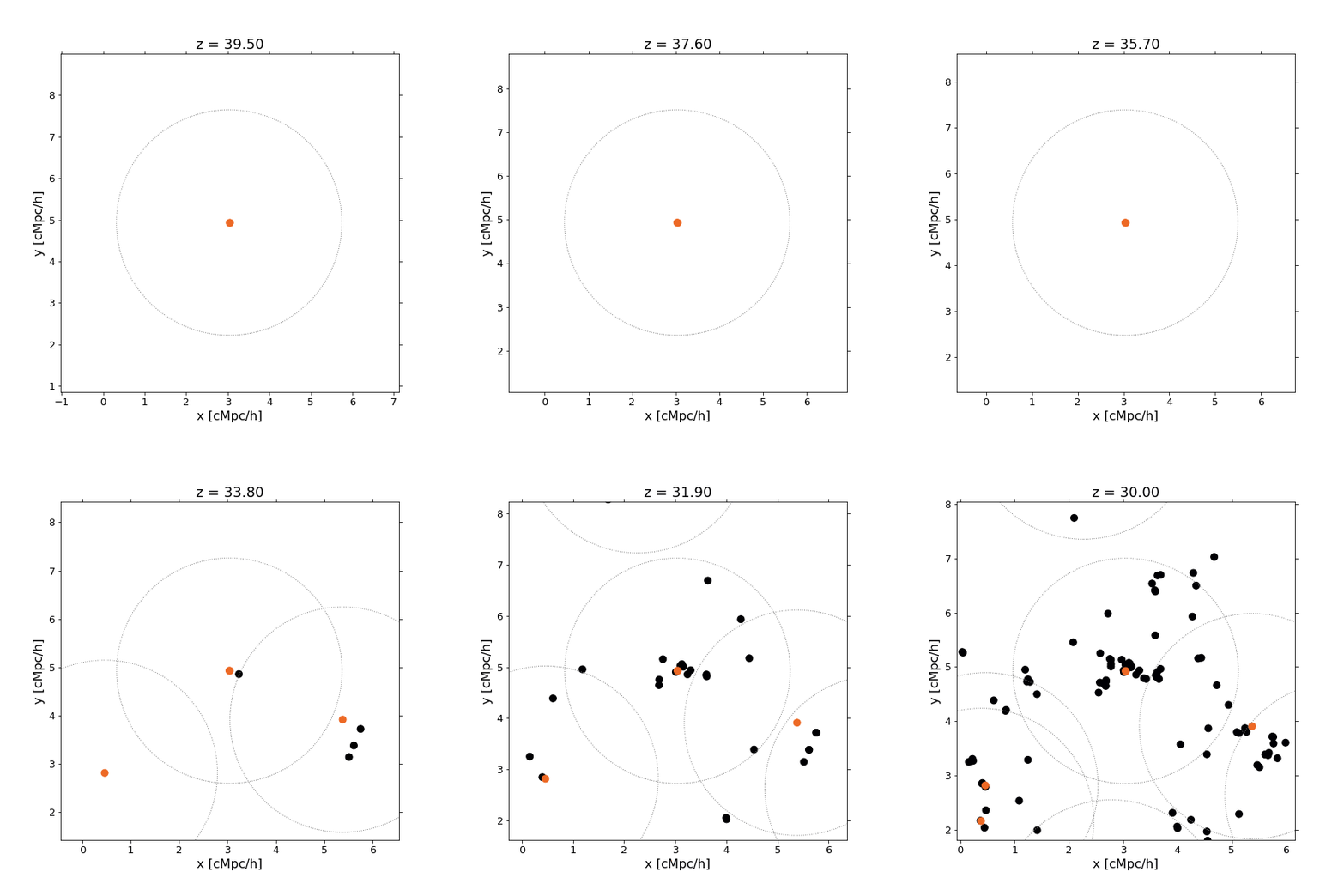
Seeded (red) and unseeded (black) mini halos in a cosmological dark matter box. A new halo is seeded only if it is a certain separation distance away from all pre-existing seeds, based on the relic H II region size of the Pop III.1 progenitors.
As Cosmic Origins Fellow within the group of Jonathan Tan at Chalmers University of Technology, I joined a collaborative project studying the origin of supermassive black holes (SMBHs) in the early universe. Within this collaboration, we explore one of the most extreme scenarios of star formation in which dark matter self-annihilation may sustain prolonged accretion onto some Population III stars and allow them to reach the supermassive regime (~10⁵ M⊙). Such stars would then become the heavy seeds of SMBHs at z~20-30. These select Pop. III stars require a pristine, non-irradiated gas reservoir in order to avoid fragmentation during their formation time, and therefore are predicted to form separated from each other by their relic H II region size. Within this collaboration, I have developed a physically motivated separation distance model based on H II region sizes. This has allowed us to populate a large dark matter simulation box with SMBH seeds in order to study their statistical properties (Petkova et al. in prep.). Our model makes predictions for some key observables as a function of redshift, such as the number density of SMBHs, the dual AGN fraction, and the gravitational waves signal generated from SMBH mergers.
-
The Evolution of Pop III.1 Protostars Powered by Dark Matter Annihilation. I. Fiducial model and first results
Nandal D, Topalakis K, Tan JC, Sergienko V, Pauchet A, Petkova MA, submitted to A&A (arXiv:2507.00870).The emergence and ionizing feedback of Pop III.1 stars as progenitors for supermassive black holes
Sanati M, Tan JC, Devriendt J, Slyz A, Martin-Alvarez S, la Torre M, Keller B, Petkova MA, Monaco P, Cammelli V, Singh J, Hayes M, MNRAS, 542, 1532 (2025).The Origin of Supermassive Black Holes from Pop III.1 Seeds
Tan JC, Singh J, Cammelli V, Sanati M, Petkova MA, Nandal D, Monaco P, proceedings of the 17th Marcel Grossmann meeting, arXiv:2412.01828 (2024).
Numerical Modelling of Feedback
Radiation-hydrodynamics scheme combining Smoothed Particle Hydrodynamics and Monte Carlo Radiative Transfer.
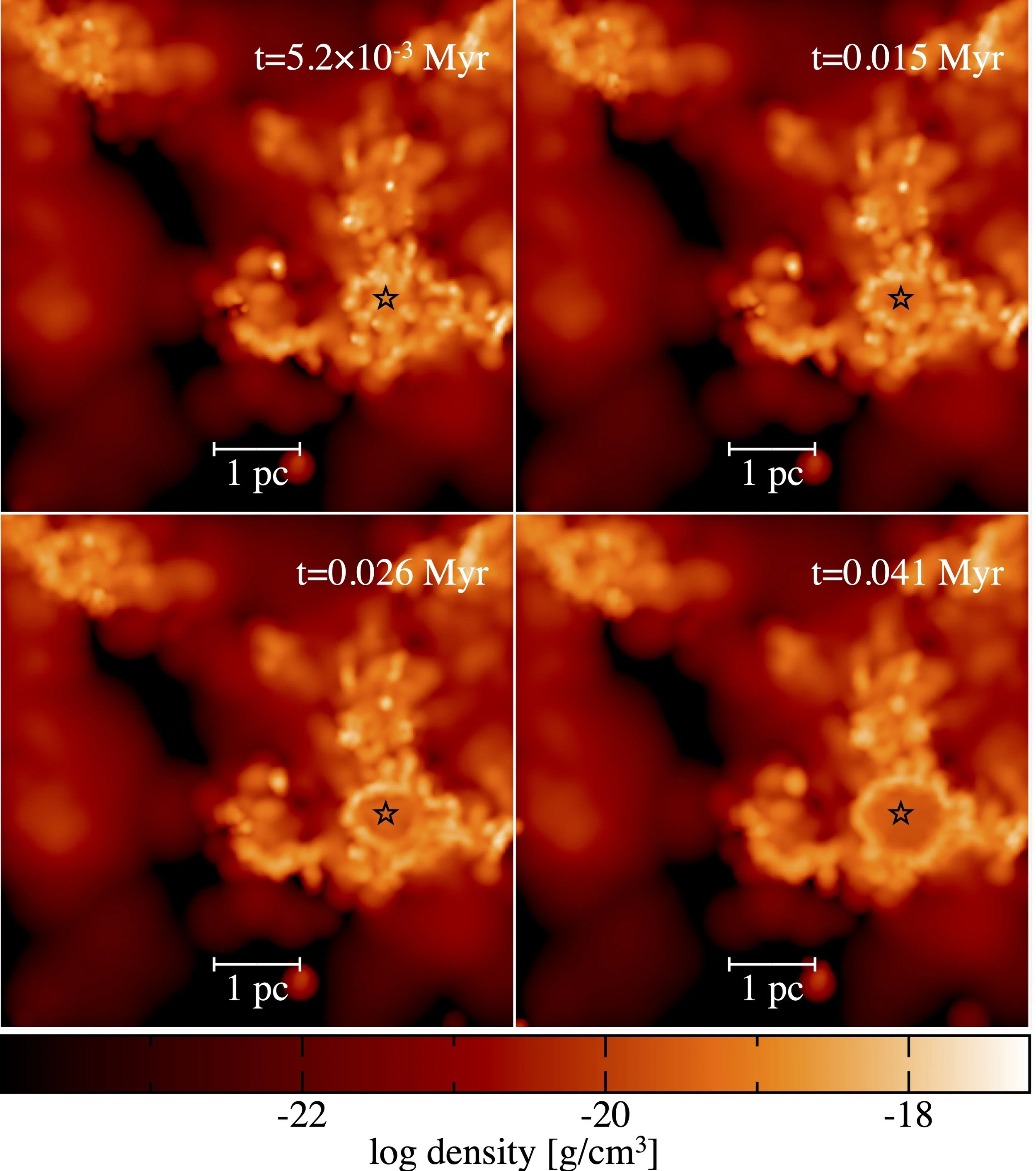
Density slices through a simulated cloud with an ionising source placed at the position of the star (Petkova et al. 2021).
Stellar feedback is how the star formation process self-regulates, and it is a key element in how small scale structures impact the larger scales. In order to better understand the impact of stellar feedback in the form of photoionisation, I embarked on a PhD degree at the University of St Andrews, UK. My project consisted of assembling a novel radiation-hydrodynamics (RHD) scheme in order to model star formation and photoionisation "on the fly" (Petkova et al. 2018, 2021). The RHD scheme is the first of its kind to combine smoothed particle hydrodynamics (SPH) and Monte Carlo radiative transfer (MCRT), using the codes Phantom (Price et al. 2018) and CMacIonize respectively (Vandenbroucke et al. 2018). The the RHD scheme was first introduced in Petkova et al. (2021), and later developed further and optimised in Lau, Petkova & Bonnell (2025). This numerical pairing has been long sought after by the community, as SPH is an excellent method for modelling star formation, and MCRT models ionising radiation with a greater degree of accuracy than most of the alternative approaches.
The main challenge in combining SPH with MCRT is the fact that SPH is particle-based, while MCRT is grid-based. In the course of my work, I identified that the mapping of SPH particle properties onto a grid was critically important for the simulation outcome, and for this reason, I developed a novel method for performing it more accurately. The method uses the integral of the SPH cubic spline kernel function over the volume of a randomly chosen polyhedron (allowing for a variety of grid types), which I derived analytically (Petkova et al. 2018). This method is more accurate than the approximate mapping commonly used by the community, and it is computationally faster than direct numerical integration. In addition to performing RHD, the method has an application in SPH simulation imaging, and it is now an integral part of the visualisation code Splash (Price 2007), as well as the Python package Sarracen (Harris & Tricco 2023).
-
Hybrid radiation hydrodynamics scheme with adaptive gravity-tree-based pseudo-particles
Lau CSC, Petkova MA, Bonnell IA, MNRAS, 538, 1461 (2025).Modelling of ionising feedback with smoothed particle hydrodynamics and Monte Carlo radiative transfer on a Voronoi grid
Petkova MA, Vandenbroucke B, Bonnell IA, Kruijssen JMD, MNRAS, 507, 858 (2021).Fast and accurate Voronoi density gridding from Lagrangian hydrodynamics data
Petkova MA, Laibe G, Bonnell IA, Journal of Computational Physics, 353, 300 (2018).